My first Game Jam: we lost, and it was okay
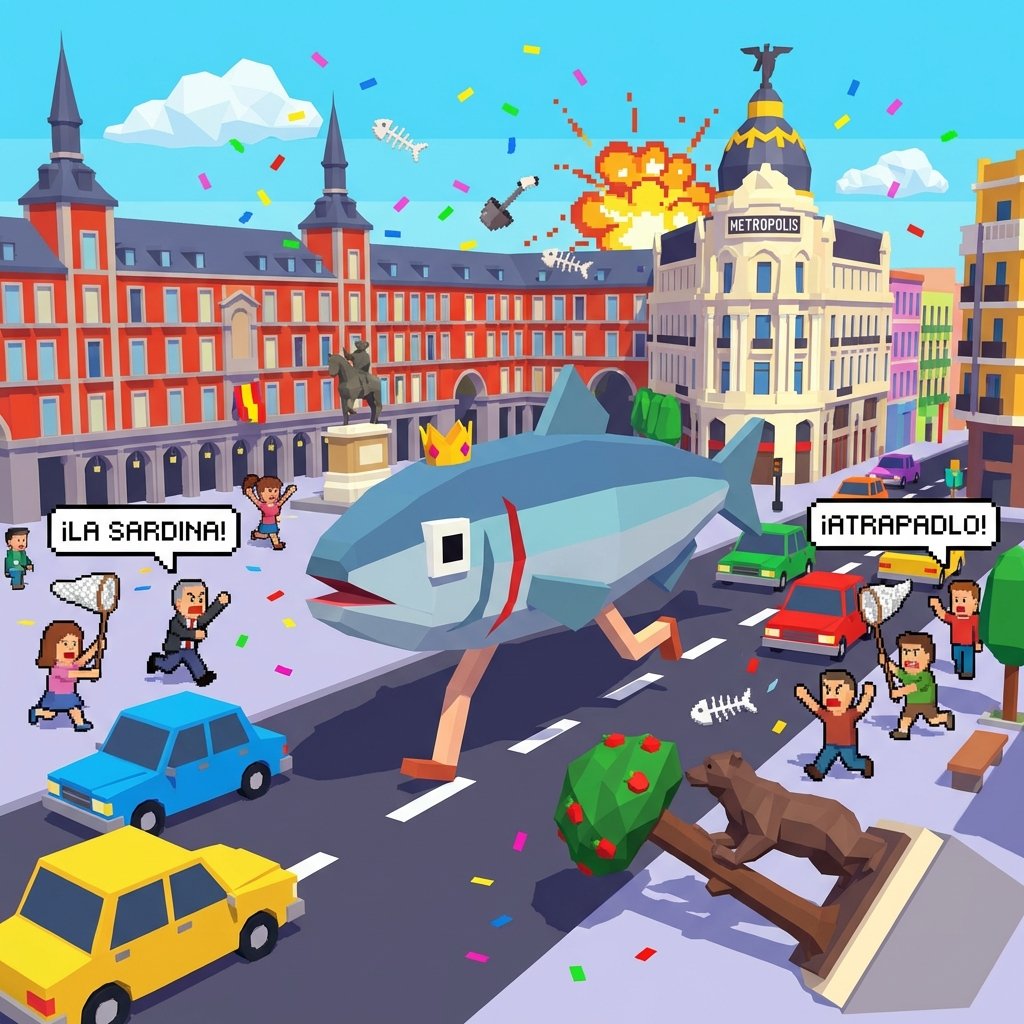
In January 2025, I participated in a hack jam for the first time. It was the Hack Jam Madrid, at the 42 Telefónica campus, organized by Madrid in Game. I arrived with excitement, eagerness, and above all, no idea how these types of competitions actually worked.
It was my first game jam experience. And I lost.
A team of only programmers
There were five of us on the team. Five programmers. Zero digital artists.
That already set the starting point quite a bit, although at that moment we weren’t fully aware of it. Within the team, I was mainly in charge of map creation, group coordination, and, as usually happens in these things, a little bit of everything.
The technical learning was huge, but also chaotic: of the five, only two had prior notions of Unity. The rest of us learned on the fly, making quick decisions, improvising, and solving problems as they appeared.
The game: a sardine fleeing through Madrid
The game is hard to pigeonhole into a specific genre, and that already says a lot. The idea was simple and absurd: a sardine fleeing through Madrid while Madrid locals try to catch it.
We decided to do it in 3D, for PC. The objective was clear and direct: survive as long as possible without getting caught.
It wasn’t a particularly functional game. It wasn’t polished. It wasn’t technically brilliant. But it was funny. Very funny. Silly. And it worked precisely because of that.
There is nothing about the game that I would defend today on a design or execution level. But the tone, the humor, and the feeling it generated while playing it had something special.
The night everything broke
We reached Saturday night, the time for the first elimination. The jury was testing our game. They were there. They liked it. Truly.
We were quite clear that we would pass to the next phase.
And then came the presentation.
We sent a disastrous presentation.
Too much text. Little visual material. Almost no graphic support.
A bore.
We didn’t pass the first phase.
I remember the feeling perfectly: a lot of frustration. After all the work, after the excitement that had been generated, the feeling that something had broken suddenly was very hard.
It wasn’t (that) bad. We sold it terribly.
With a cool head, the game had many shortcomings, of course. Most of the art was pre-bought assets and elements generated with AI. It couldn’t be otherwise: we were five programmers without an artist and with a huge barrier in that aspect.
But the problem wasn’t just the game.
The problem was how we presented it.
Part of the jury, the one that had seen the game in person, did understand it. They even liked it. The other part, the one that hadn’t tried it, had no option to understand it with such a poor presentation.
And there is the phrase that stuck with me:
“A good product (not saying ours was), poorly sold, goes nowhere.”
What I would have done differently
Without touching a single line of code, today I have it clear:
- I would have looked for an artistic profile for the team
- I would have prepared a trailer
- I would have used GIFs, images, colors
- I would have bet on a dynamic and visual presentation
- Less text, less explanation
- More impact, more emotion
Because in the end, a picture is worth a thousand words.
What I really learned
This defeat didn’t take away my confidence. On the contrary: it pushed me to want to do better.
I learned something that I apply to any project today, not just games: it’s not enough to make something, you have to sell it well. And you have to put extra energy into everything you do.
I also understood that I was too ambitious. Expecting to reach the final in my first hack jam, without prior experience and with barely any knowledge of video game development, seen from today, was unrealistic.
But it had to happen.
If I could talk to my self from back then
I would tell him not to let the defeat affect him so much. Although it would be hypocritical, because if I lost again today, I would probably feel the same or worse.
And it’s okay for it to be like that.
Losing that hack jam was necessary. It taught me how a real competition works, what is valued, what mistakes not to make again and, above all, it gave me the desire to return.
Because now I know how to do it better.
COMENTARIOS
Comparte tu opinión
Powered by Open Source • Privacy Focused • No Tracking